
The instinctive image of an AI copyright lawsuit is an individual: Sarah Andersen finding her illustrations inside a training set, Getty Images tracing its photo library into Stable Diffusion. That image was accurate for a while. Individual artists, authors and musicians filed six in ten of the AI copyright suits tracked here in 2023 and 2024.
It stopped being accurate in 2025. Individual creators filed just two of that year’s fifteen new cases; commercial rights holders, publishers, book publishers, music labels, filed eleven. The word “copyright” hasn’t changed. What it’s being used to describe has: a consent dispute over training data has been overtaken, in raw filing volume, by a licensing dispute over commercial content, and one legal label now covers both.
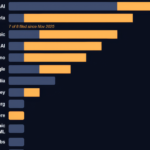
Who's Suing Whom in AI — 55 Cases, 2023–2026
Every defendant, every plaintiff, one map. Tap a node to trace the threads.
Tap or hover any company or plaintiff to trace its cases — tap the background to reset. Scroll sideways to see the full map on a small screen.
Circle size = number of cases naming that company as lead defendant. Multi-defendant suits are attributed to the first-named defendant only. Source: Information is Beautiful AI litigation tracker, cross-referenced against court filings, compiled May 2026.
Every case in the tracker is in the map above; every plaintiff, every defendant, coloured by who’s suing. Click through it before reading on. One pattern doesn’t need explaining.
Click Perplexity, and the pattern is obvious before you read a word
Litigation should track size; bigger balance sheets, bigger targets. Trace the lines running into Perplexity AI’s circle above and that pattern breaks immediately. A company sitting well outside the top tier of most-used AI tools by traffic, running mostly on other labs’ models rather than its own, is named in eight of the cases tracked here; almost as many as Meta, a company many times its size. Nearly every line into Perplexity is violet: a publisher, not a creator. The mechanism is product surface, not revenue. Perplexity’s product is real-time retrieval and summarisation of exactly the content publishers license, which competes with a visit to the original site every time it runs. A structurally different complaint from “you trained on my work once.”
None of that needed a calendar. Who’s connected to whom is visible the moment you click. But the map has no sense of time built into it. It shows that a connection exists, not when it formed. Layer dates back in, and a second story appears, one about timing rather than who’s involved.
For eleven months of 2025, almost no individual creator filed a new AI copyright suit
The 2023–24 wave implied a steady drumbeat of individual plaintiffs that would keep building. It didn’t. From January to November 2025, zero new suits in this tracker came from an individual creator; the only two that year, a New York Times reporter and a coalition of YouTubers, both arrived in December. The mechanism is consolidation, not disappearance. Most 2023–24 plaintiffs weren’t dozens of separate grievances; they were a handful of test cases (Andersen v. Stability AI, Bartz v. Anthropic, Authors Guild v. OpenAI) that pulled new claimants into a small number of actions already moving through court, leaving little reason for a new individual to file rather than join one already filed.
The shift arrived before the settlement that was supposed to explain it
The obvious read is that Anthropic’s record settlement gave institutional plaintiffs the incentive to pile in. The Authors Guild’s own timeline puts the figure at the centre of that story. Anthropic agreed to pay $1.5 billion in September 2025, reported at the time as the largest copyright settlement in US history. But commercial rights holders had already filed most of the year’s cases by February. Chegg, Condé Nast and Thomson Reuters were all in court seven months before that figure existed. The causal story runs backwards. Whatever moved institutional counsel to file in early 2025, it wasn’t a number a court hadn’t yet set.
Even creators’ 2026 comeback is downstream of the same settlement
Four individual creators have filed new suits in 2026 so far, which could read as the original wave regaining ground. Two of them aren’t that. Cruz v. Anthropic and a parallel suit brought by author R.O. Kwon and others were both filed by authors who explicitly opted out of the Bartz settlement to pursue their own claims rather than accept a flat per-work payout. That isn’t a new grievance finding its voice. It’s unresolved business from the old one, running through a different procedural door.
A companion piece ranks every company in this tracker by how often it’s been named as a defendant — and finds the same ranking hides very different timelines underneath it. See who’s climbing fastest.
Methodology
This piece tracks 55 publicly reported AI copyright and intellectual-property lawsuits filed in the United States between February 2023 and May 2026, compiled by Information is Beautiful and cross-referenced against court dockets (CourtListener) and press coverage. In the map, circle size for each defendant reflects the number of cases naming that company as lead defendant; cases naming multiple defendants are attributed to the first-named company only, so a company’s true involvement in multi-defendant suits may be understated. Plaintiffs are grouped into three categories: individual creators (artists, authors, musicians and video creators filing in their own name), commercial rights holders (publishers, book publishers, music labels and other companies whose primary business is licensing content), and platforms (companies whose primary business is hosting content rather than licensing it). The map has no time dimension; the year-by-year figures cited in the text are drawn from the same underlying tracker. Two cases with no confirmed filing month are excluded from year totals. 2026 figures cover January–May only and aren’t directly comparable to full-year totals. Annual sample sizes are modest (8–17 cases); year-on-year percentages should be read as a directional trend within a curated tracker of notable cases, not a statistical census of all AI-related litigation. Revenue and valuation figures in the underlying dataset were not independently verified and aren’t used in either the map or the figures above.

One thought on “Who’s Suing Whom in AI: The Plaintiffs Changed in 2025; the Word “Copyright” Didn’t”