
“Jobs at risk from AI” is the framing every quarterly report runs, and the assumption behind it is intuitive enough to look like fact. The reading assumes that the most exposed work sits at the bottom of the labour market, i.e., routine, low-paid, easy to script. When researchers from Princeton, Penn and OpenAI separately ranked occupations by AI exposure, the lists agreed in an awkward way. The most-exposed jobs are predominantly professional, knowledge-based and well-paid.
The mechanism is in the word. “Exposure” measures the share of an occupation’s tasks that language models can plausibly perform. That is a measure of overlap with model capabilities, not of which jobs will disappear. Disaggregate the two, toggle this chart from exposure to median wage, and the popular reading inverts. The jobs most amenable to AI assistance are paid for the things AI is now amenable to assisting with. Whether that ends in augmentation or substitution is a separate question, and the exposure score on its own cannot answer it.
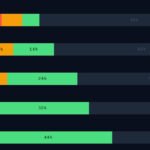
The 40 Occupations Most Exposed to AI
Ranked by the Felten-Raj-Seamans AI Occupational Exposure index. Toggle to median wage and the bars stay near the top of the pay distribution.
The list isn’t the bottom of the labour market; it’s the top
“AI is coming for low-paid jobs” recycles the assumption that automation always works downwards. The exposure indices say otherwise. Of the top forty AI-exposed occupations in the Felten-Raj-Seamans index, more than two-thirds pay above the US workforce median wage of $48,060. The handful of low-wage entries (telemarketers, court reporters, legal secretaries) read as confirmation of the panic narrative because they fit the script. The other twenty-eight don’t. Lawyers, accountants, software developers, financial advisors, statisticians, university lecturers, these form the bulk of the list. Exposure tracks tasks AI can do, and AI can do a great deal of professional knowledge work. The pattern is the inverse of the one implied by industry-level displacement forecasts, which sort by share-of-tasks-automatable rather than by the position of those tasks in the wage distribution.
Telemarketers and telephone operators don’t share a fate
The closest test of the displacement reading is its own internal contradiction. Telemarketers sit at the top of the AI exposure list. Telephone operators, a job that has been hollowed out by automation since the 1960s, with the workforce shrinking by more than 95% over five decades, don’t reach the top forty at all. The methodology gives a clean reason. Telephone operators’ core tasks (connecting calls, directing queries) were automated by switchboard technology long before language models existed, and what remains of the role no longer overlaps much with what an LLM does. Telemarketers’ tasks (scripted persuasion, objection handling, lead qualification) sit squarely in LLM territory today. “Most exposed” and “most replaceable” point in different directions because exposure measures overlap with current capability, not the structural conditions under which jobs vanish. One is a snapshot. The other is a process.
The wage correlation breaks the panic narrative; and replaces it with a harder one
Toggle the chart to median wage and the visual is uneven but consistent: the bars don’t collapse to the left. The median wage across the top forty AI-exposed occupations is roughly $82,000 – well above the US workforce median. Pew Research’s 2023 analysis reproduced the same correlation using a different methodology. What that implies depends on which mechanism you weight. The augmentation reading says high-wage workers gain productivity from AI tools and stay employed at higher output. The substitution reading says employers facing $82,000 salaries have stronger incentives to replace tasks than employers facing $30,000 ones. Both are consistent with the data. Neither is consistent with the popular framing that “AI is coming for the working class”; and the harder version, that the jobs most worth substituting are the ones it costs most to keep, is the conversation the displacement framing has been crowding out.
What “exposure” doesn’t measure is most of the answer
The slippage worth flagging is what the index leaves out. Exposure doesn’t measure adoption; whether employers actually deploy AI for the tasks it can perform. It doesn’t measure cost; whether the substitution is cheaper than the human, factoring in error rates, integration, oversight and liability. It doesn’t measure regulation; whether law or professional licensure makes substitution impractical regardless of capability. And it doesn’t measure the parts of the role that don’t appear in any task list: client relationships, organisational politics, accountability, judgement that takes a career to develop. Lawyers and accountants score high on exposure because the document-processing parts of their work are tractable to language models. The parts that make them lawyers and accountants, and that bill at £400 an hour, are not the parts the index measures. A high score is the ceiling on what AI could plausibly touch in the role. Not a forecast of what it will.
Methodology note
Primary source: Felten, Raj and Seamans, “Occupational Heterogeneity in Exposure to Generative AI” (SSRN, 2023 update). The AI Occupational Exposure (AIOE) score maps occupational tasks drawn from the US Department of Labor’s O*NET database against ten AI capability domains, weighted by recent progress in each domain. Higher scores indicate a larger share of the occupation’s task profile that current language models can plausibly perform. Scores are normalised to a 0–1 scale; ordering follows the published replication ranking, with ties broken by underlying task-overlap weights. Wage figures are US Bureau of Labor Statistics Occupational Employment and Wage Statistics, May 2024 release, matched to each occupation’s Standard Occupational Classification (SOC) code. The US workforce median wage of $48,060 is the May 2024 BLS national figure for all occupations. Findings are cross-referenced with Eloundou et al. (OpenAI, 2023) and Pew Research Center’s 2023 occupational exposure analysis, both of which produce convergent results: AI exposure concentrates in professional, knowledge-intensive and managerial occupations. The UK Department for Education’s “Impact of AI on UK jobs and training” (2023) adapted the Felten-Raj-Seamans methodology to UK Standard Occupational Classification codes and reproduced the central pattern — the same methodology used in our UK sector-level exposure analysis. Exposure measures task overlap with model capabilities. It does not measure adoption, cost-effectiveness of substitution, regulatory constraints, or the share of any role that consists of non-task work — these jointly determine whether exposure translates into displacement, augmentation, or no change at all.

One thought on “Ranked: The 40 Jobs Most Exposed to AI”